

We know that in traditional SEO practices, keyword research is a fundamental task, much like the foundation of a building. If the foundation is not solid, the building will not stand.
However, in the AEO era, keyword research is no longer as important. Why? Because AEO is no longer driven by the logic of search engines; it’s no longer a keywords-centered game.
You no longer need to download keyword lists, filter them based on the AIDA marketing model, and then organize your on-site SEO based on search intent.
I know that for most people, keyword research is a tedious task. For those of you, you should be grateful for the arrival of AEO, as you no longer need to agonize over keyword lists.
In the AEO era, all these tasks are gone.
In AEO keyword research, you only need to find keywords that trigger AIO (AI Overview) and then write your articles around these keywords.
What are AIO Keywords?
We can call them Keywords, or we can call them sentences. The key feature of AEO keywords is that they are long phrases, and AIO keywords are those that trigger AIO overviews.
For example, when we search for “AIO Keywords Meaning,” it triggers an AIO overview.
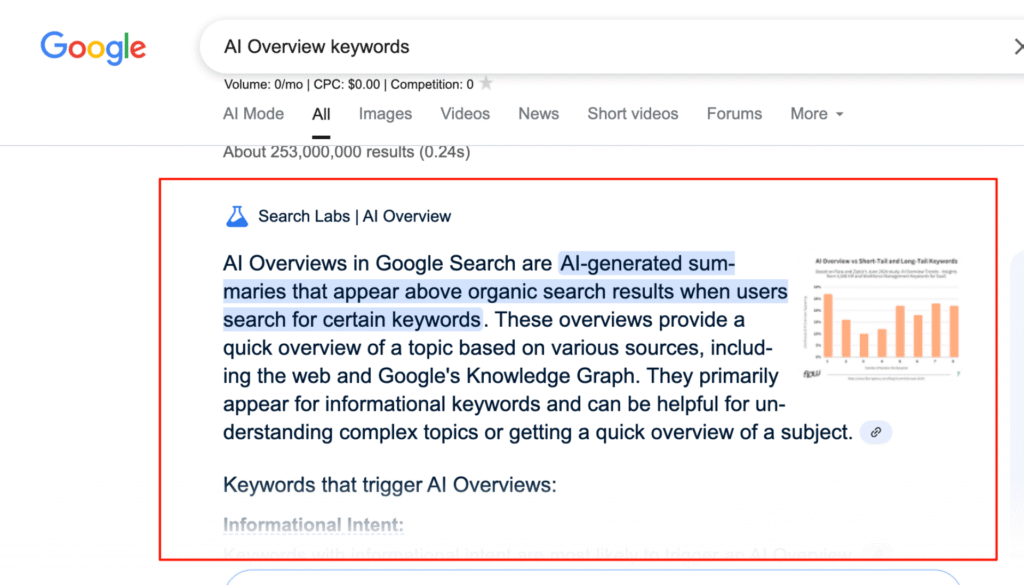
Keywords that don’t trigger AIO are called SEO keywords.
Currently, compared to SEO keywords, AIO keywords are still a minority. Traditional SEO keywords account for 70% of all search keywords.
Advancedwebranking.com conducted an experiment with 8,000 keywords, scraping them to calculate the ratio between AIO and traditional SEO keywords. The result showed that AIO keywords account for less than 20%, while most still fall under SEO keywords.
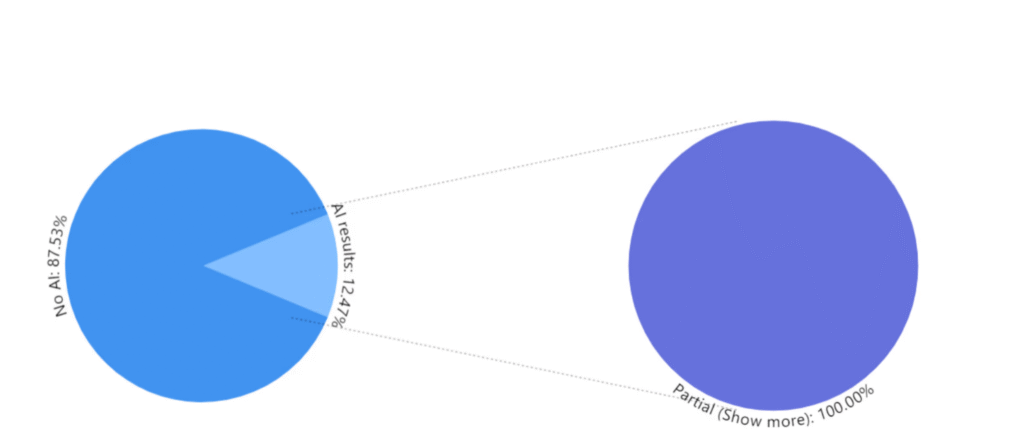
Image source: advancedwebranking.com
If you’re interested, you can read their detailed research article here:
8000 Keywords AI Overview Study
Comparison Between AIO Keywords and SEO Keywords
Search Intent
SEO keywords are more focused on general intent. When users search these keywords, they often don’t have a very clear intent. These are the so-called broad keywords, which have diverse search intents, and from a marketing perspective, the ROI is typically low.
AIO keywords have very clear search intent. Users are searching with specific questions, looking for the most accurate answer as quickly as possible.
Keyword Length
Traditional SEO keywords typically range from 1-3 words, while AIO keywords tend to range from 5-8 words, often starting with phrases like “What is,” “How to,” or “guide.”
According to traditional SEO, these keywords would fall under the awareness stage of the marketing funnel.
Types of AIO Results
This is an interesting question. By studying the types of results triggered by AIO overviews, we can determine what we should focus on when optimizing our website content.
Here’s the breakdown of AIO result types:
- Text paragraphs: 24%
- Bullet-point lists: 40%
- Image lists: 34%
- Topics: 1%
From the AIO result type percentages, we can infer that if your page is well-optimized with schema markup, it’s more likely to appear in AIO results.
Schema markup is the key, the key, the key to AEO!
Will AIO Keywords Affect Traditional SEO Keywords?
The answer is both yes and no.
AIO keywords that can affect traditional SEO rankings are mostly those with 4 or more words. For most keywords that are already well-established on Google’s first page, AIO is unlikely to steal traffic in the short term.
If you notice that your company’s website has dominant keywords ranking on Google’s first page, don’t worry—AIO won’t significantly harm you in the short term. However, whether you can continue to hold those positions in the future is uncertain.
On the other hand, for smaller websites that rely on long-tail keywords, AIO is a fatal blow. This is the root cause of zero-click searches: users have already found the answers they need through AIO, so they no longer need to browse through websites.
However, this also presents an opportunity for websites that haven’t ranked high in traditional SEO. You now have a 50% chance of appearing in AIO.
AIO Keyword Research Methods
Currently, both Ahrefs and Semrush have AIO keyword features. Let’s use Ahrefs as an example to show you how to do this.
AIO Keyword Research Steps:
- In the Ahrefs backend, enter your main product keyword in the Keyword Explorer
- Click to view all keywords.
- In the SERP above, select “not on SERP + AI Overview,” and filter out keywords that do not appear in traditional SERP but trigger AIO.
- Export these AIO-triggering keywords as topics for future article writing.
Here’s a little teaser: If you have trouble coming up with article topics based on these AIO keywords, you can actually use precise prompts to have AI help you choose topics and guide you step by step to create high-quality articles automatically.