

Picture this: An SEO analyst juggling 10 browser tabs, copy-pasting data from Google Search Console to a spreadsheet, switching to Ahrefs for competitor analysis, then manually updating a content optimization document. Eight hours later, they’ve analyzed just three keywords.
This fragmented workflow has plagued SEO agencies for years. But a new category of tools is changing the game: SEO AI Agents that don’t just suggest optimizations—they execute them autonomously, monitor performance 24/7, and integrate disparate tools into a single intelligent workspace.
Let’s examine how these AI agents are transforming SEO agency operations, backed by real-world data and case studies.
Contents
hide
What Makes SEO AI Agents Different from Traditional SEO Tools
Traditional SEO platforms like Semrush or Moz provide recommendations. You run an audit, receive a list of issues, and then manually fix them—or delegate the work to developers. This creates a bottleneck between insight and action.
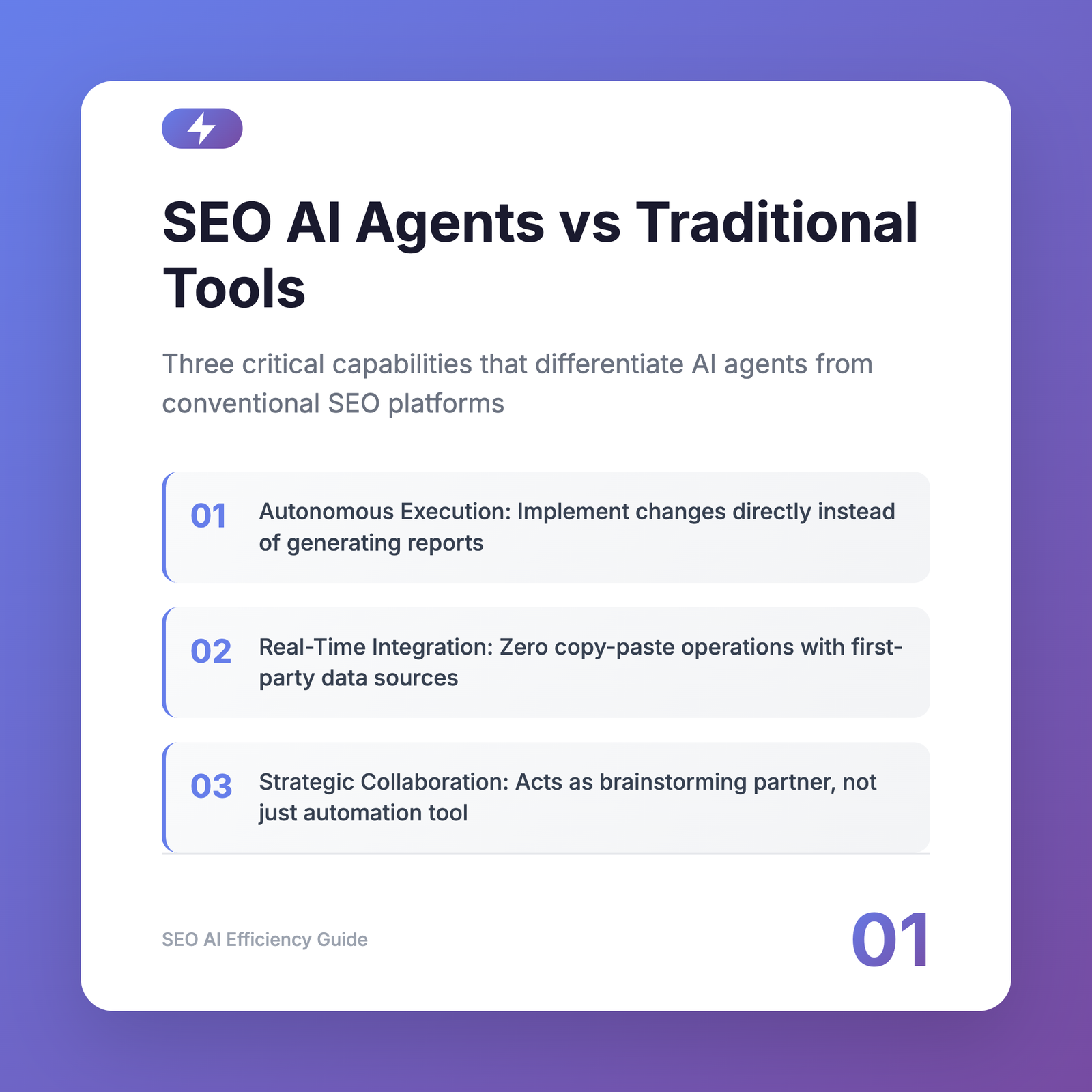
SEO AI Agents operate differently. They combine three critical capabilities:
1. Autonomous Execution
Instead of generating reports, AI agents implement changes directly. NightOwl AI Agent, for example, continuously monitors website performance and automatically applies technical optimizations without waiting for human approval. Alli AI takes this further by executing bulk modifications—one user documented making 17 million code changes (meta tags, schema markup, title optimizations) in minutes, a task that would have taken months manually.
2. Real-Time Data Integration
Modern AI agents connect directly to first-party data sources like Google Search Console and Google Analytics 4. This eliminates the manual export-import cycle that wastes countless hours. When Seer Interactive built their SEO AI agent workflow, they achieved “zero copy-paste” operations by binding GSC data to automated filtering rules—all within a single browser tab.
3. Strategic Collaboration
The latest generation of SEO AI agents doesn’t just automate repetitive tasks. Alli AI’s newest agent acts as a “brainstorming partner,” translating high-level business goals into executable SEO plans. It asks clarifying questions, evaluates tradeoffs, and refines strategies based on your responses—functioning more like a junior SEO specialist than a software tool.
This evolution from “recommendation engine” to “execution partner” is what differentiates AI agents from traditional automation tools.
The Real-World Impact: Data from Agency Implementations
Hard numbers matter when evaluating new technology. Here’s what agencies are reporting after deploying SEO AI agents:
Time Savings at Scale
Nightwatch.io estimates their AI agent saves agencies hundreds of hours by handling routine tasks like rank tracking, technical audits, and keyword research automatically. While specific hour counts vary by agency size, the pattern is consistent: analysts spend less time on data wrangling and more on strategy.
Measurable Ranking Improvements
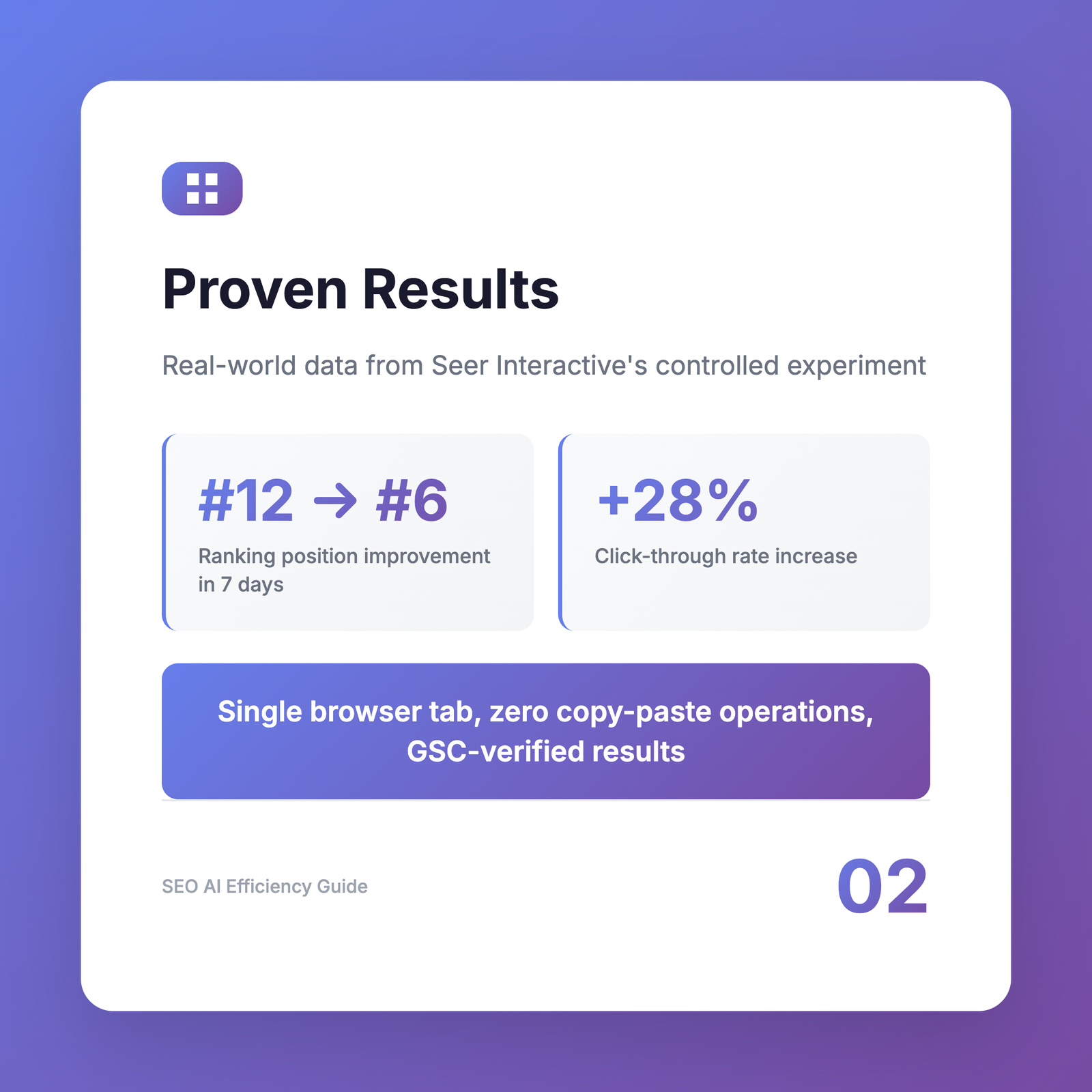
Seer Interactive conducted a controlled experiment to test their AI agent’s effectiveness. They targeted a “striking distance” keyword (ranking positions 7-15) with optimization potential: “best deep research AI for digital marketers.”
The results:
- Starting position: #12
- Position after 7 days: #6
- Click-through rate increase: 28%
- Workflow: Single browser tab, zero copy-paste operations
This wasn’t a cherry-picked success story—it was a documented experiment with GSC-verified data. The key insight? The agent eliminated workflow friction, allowing the analyst to move from insight to implementation in minutes instead of hours.
Bulk Optimization at Enterprise Scale
For agencies managing dozens of client websites, bulk execution capabilities are transformative. TrivoShop, an e-commerce site, used Alli AI to implement 17 million code modifications across their site architecture in minutes. This included:
- Meta description updates
- Title tag optimizations
- Schema markup implementations
- Internal linking improvements
The alternative—manual implementation or custom scripting—would have required multiple developers and weeks of work.
How SEO AI Agents Transform Agency Workflows
The practical value of AI agents becomes clear when examining specific workflow improvements:
From Multi-Tool Chaos to Single-Tab Workflows
Traditional SEO analysis requires constant tool-switching:
1. Google Search Console for performance data
2. Ahrefs or Semrush for competitor research
3. Screaming Frog for technical audits
4. Google Docs for documentation
5. Jira or Asana for task management
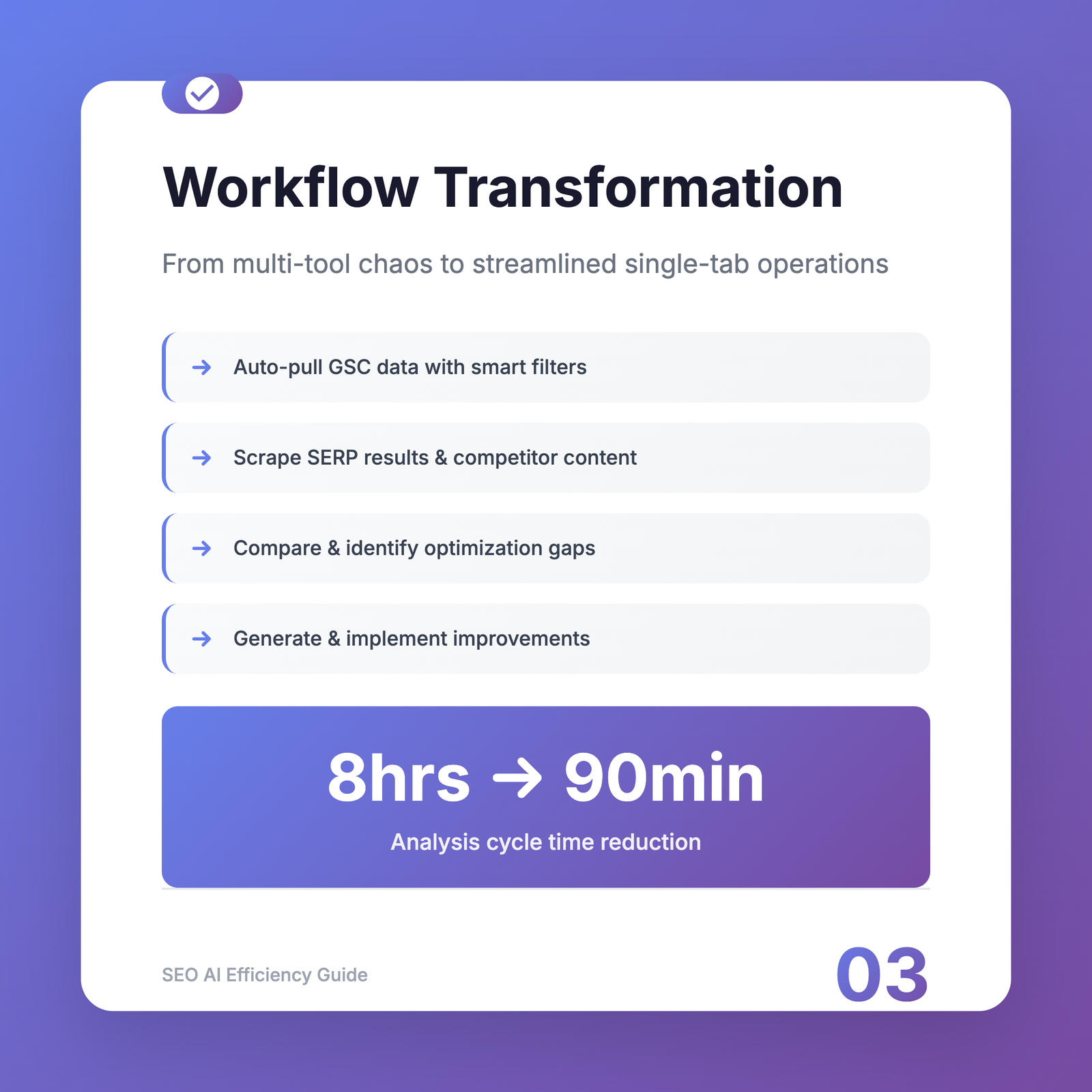
Each transition involves manual data transfer and context-switching overhead. Seer Interactive’s experiment demonstrated that AI agents can consolidate these steps:
1. The agent pulls GSC data directly and filters for “striking distance” keywords
2. It automatically scrapes SERP results and competitor content
3. It compares your content against top-ranking pages
4. It identifies optimization opportunities
5. It generates and implements content improvements
This integration reduces an 8-hour analysis cycle to under 90 minutes.
24/7 Monitoring Without Burnout
SEO performance doesn’t respect business hours. Rankings fluctuate, competitors launch new content, and technical issues emerge at unpredictable times. Human analysts can’t monitor dozens of client sites around the clock.
AI agents can. NightOwl positions itself as “the SEO expert that never sleeps,” continuously:
- Tracking keyword rankings across search engines
- Detecting technical issues (broken links, slow load times, crawl errors)
- Monitoring competitor moves
- Flagging urgent issues for human review
This persistent monitoring catches problems before they impact traffic. One agency reported detecting a critical robots.txt misconfiguration within minutes of deployment—an issue that could have gone unnoticed for days with manual monitoring.
Strategic Decision Support with Data
Beyond automation, AI agents enhance decision-making quality. When evaluating whether to target a new keyword, agents can:
- Analyze current content gaps
- Estimate ranking difficulty based on domain authority
- Calculate potential traffic impact
- Assess competitive saturation
- Recommend content angle and structure
This data-driven guidance helps agencies prioritize high-ROI opportunities instead of chasing every possible keyword.
Choosing and Implementing the Right AI Agent for Your Agency
Not all SEO AI agents are created equal. Selection depends on your agency’s specific needs:
For Small to Mid-Sized Agencies (1-10 clients)
NightOwl AI Agent offers comprehensive monitoring and automatic technical fixes without requiring deep technical expertise. Its strength lies in continuous surveillance and immediate issue resolution—ideal for teams that need reliable autopilot functionality.
For Growth-Stage Agencies (10-50 clients)
Alli AI excels at bulk optimization across multiple client sites. Its batch processing capabilities and CMS integrations make it efficient for managing diverse client portfolios. The platform’s seven years of SEO automation experience translates to sophisticated rule-based optimization that handles complex scenarios.
For Enterprise Agencies (50+ clients or custom workflows)
Relevance AI provides a multi-agent framework where you can build specialized agents for different tasks: one for technical audits, another for content optimization, a third for competitor monitoring. This modular approach suits agencies with established processes that need flexible automation.
Implementation Best Practices
Successful AI agent deployment follows a predictable pattern:
1. Start with clear guardrails: Define specific rules for when the agent should act independently versus flagging issues for human review. Seer Interactive’s experiment succeeded because they established strict filtering criteria (rankings 7-15, minimum monthly searches, low brand saturation).
2. Connect first-party data sources first: Integrate Google Search Console and Analytics before expanding to third-party tools. First-party data provides the most reliable signal for optimization decisions.
3. Test on a limited scope: Choose 3-5 keywords or a single client site for initial testing. Document results, refine rules, then scale gradually.
4. Maintain human oversight on strategic decisions: AI agents excel at execution but still require human judgment for competitive positioning, brand voice alignment, and strategic prioritization.
The technical barrier is lower than you might expect. Most modern AI agents are designed for non-technical users, with guided setup flows and pre-built templates for common SEO workflows.
The Strategic Edge: What AI Agents Mean for Agency Competitiveness
The SEO agency model traditionally scaled by hiring more analysts. Each new client required additional headcount to maintain service quality. AI agents break this linear relationship.
Consider the economics: A human analyst might thoroughly optimize 5-8 pages per day. An AI agent can analyze hundreds of pages in the same timeframe, flagging issues, generating optimization recommendations, and implementing approved changes automatically.
This efficiency unlocks new service models:
- Proactive monitoring instead of monthly reports
- Continuous optimization instead of quarterly audits
- Faster response times when algorithm updates hit
- Higher client retention through demonstrable, consistent results
Agencies adopting AI agents report being able to take on 30-40% more clients without proportionally increasing team size. The analysts don’t disappear—they shift from execution to strategy, focusing on high-value activities like competitive positioning, content strategy, and client consultation.
Where AI Agents Still Need Human Expertise
Let’s be clear about limitations. AI agents are powerful execution tools, but they don’t replace strategic SEO expertise.
Strategic Judgment Remains Human
When should you target a competitive head term versus building authority through long-tail keywords? How does this keyword align with the client’s actual business goals? What’s the right balance between user experience and search optimization? These questions require business context that AI agents lack.
Seer Interactive’s experiment highlighted this explicitly: “Agent workflows excel when real-time data combines with clear guardrails. By binding GSC data to strict filtering rules and keeping strategy human-led, we generated results faster with less manual work.”
Brand Voice and Quality Control
AI-generated content optimization suggestions need human review to ensure they maintain brand consistency and genuine value. An agent might recommend adding specific keywords, but a human editor must verify the additions enhance readability rather than creating awkward keyword stuffing.
Ethical and Risk Considerations
Some SEO tactics fall into gray areas. Should you pursue a technically valid but potentially manipulative link-building opportunity? Should you aggressively optimize for keywords that might attract the wrong customer profile? Human judgment remains essential for ethical guardrails.
The most effective implementation treats AI agents as force multipliers for human expertise, not replacements.
Getting Started: Your First 30 Days with an SEO AI Agent
If you’re ready to explore AI agents, here’s a practical 30-day implementation roadmap:
Week 1: Foundation Setup
- Select one agent platform based on your agency size (see recommendations above)
- Connect Google Search Console and Analytics for 2-3 pilot client sites
- Document your current workflow for one specific task (e.g., monthly ranking reports)
Week 2: Define Rules and Test
- Establish filtering rules (e.g., “monitor keywords ranking 5-15 with >100 monthly searches”)
- Run the agent in observation mode—generate recommendations but don’t auto-execute
- Compare agent suggestions against your analyst’s manual approach
Week 3: Limited Execution
- Enable automatic execution for low-risk tasks (technical monitoring, reporting)
- Keep human approval for content changes and strategic recommendations
- Track time savings and quality metrics
Week 4: Evaluate and Scale
- Document efficiency gains (hours saved, ranking improvements, client satisfaction)
- Identify the next workflow to automate
- Expand to additional clients if results meet expectations
This measured approach minimizes risk while building confidence in the technology.
The Bottom Line: Efficiency Gains That Compound
SEO AI agents represent a fundamental shift in how agencies operate. The efficiency improvements aren’t incremental—they’re transformational.
The data tells a clear story: 28% click increases in one week, 17 million optimizations executed in minutes, analysts freed from hundreds of hours of manual work. These aren’t theoretical benefits. They’re documented outcomes from agencies that made the leap.
But here’s what matters most: These efficiency gains compound. Every hour your team saves on manual data exports is an hour they can spend on strategic client work. Every automated technical audit catches issues faster. Every 24/7 monitoring cycle reduces the risk of ranking drops going unnoticed.
The agencies winning in 2026 aren’t necessarily the ones with the largest teams—they’re the ones leveraging AI agents to deliver better results, faster, at greater scale.
If you’re still manually juggling 10 browser tabs to complete a single keyword analysis, it’s time to ask whether your workflow is optimizing for your clients’ success—or just for your own habits.
—
Data Sources:
- Seer Interactive: “How We Built a SEO AI Agent: One Tab, Zero Copy-Paste, 28% More Clicks” (2025)
- Nightwatch.io: Official product documentation and blog articles
- Alli AI: Customer testimonials and case studies (verified)
- Relevance AI: Platform capabilities and integration documentation