

Contents
hide
Elevating Digital Performance: AI-Driven Website Speed Optimization
In a world where digital attention spans are fleeting and expectations for instantaneous access are absolute, the speed at which your brand’s story unfolds online is paramount. It is no longer a mere technicality but a foundational element of strategic digital presence. The relentless demands for lightning-fast digital experiences have pushed traditional website optimization methods to their limits, highlighting their inherent challenges in dynamic, algorithm-driven environments.
This guide explores the strategic intersection of artificial intelligence and website performance, defining AI-powered optimization as a sophisticated methodology employing machine learning and predictive analytics to enhance site speed and responsiveness. This directly impacts user experience (UX), elevates SEO rankings—particularly through Google’s Core Web Vitals—and profoundly influences conversion rates and overall business success. We will explore how AI is not just an enhancement but a transformative force, enabling unprecedented levels of efficiency and strategic foresight in optimizing digital assets. This document serves as a definitive resource for discerning professionals seeking to leverage AI for superior website performance.
The Imperative of Speed: Why AI Redefines Website Optimization
The digital realm operates at the speed of thought. Users expect instantaneous access, and search engines reward the most fluid experiences. Traditional optimization, often reliant on manual analysis and static adjustments, struggles to keep pace with the dynamic nature of user behavior, content updates, and evolving algorithmic demands. AI, however, introduces a fundamental shift in how performance is managed.
AI-powered website speed optimization harnesses sophisticated algorithms to intelligently analyze vast datasets, predict user interaction patterns, and autonomously implement enhancements. This proactive and continuous approach elevates the discussion from mere technical fixes to strategic digital architecture. Every millisecond contributes to a brand’s authority and trust. For visionary enterprises, adopting AI for speed optimization is not merely about achieving faster load times; it is about cultivating a digital ecosystem that anticipates, adapts, and excels, ensuring their presence is not just found, but remembered.

For a deeper understanding of how these foundational elements intertwine, explore our detailed analysis on The Impact of Website Speed on SEO and User Experience.
Beyond Conventional Methods: How AI Revolutionizes Speed Optimization
The difference between traditional and AI-powered website optimization is significant. Traditional methods, while foundational, often involve manual processes: static caching, basic image compression, and periodic code reviews. These approaches are reactive, time-consuming, and demand constant human intervention to maintain efficacy.
AI-powered optimization, conversely, operates on principles of continuous learning and autonomous action. It employs a suite of advanced technologies:
- Machine Learning (ML): Algorithms learn from vast amounts of user behavior data, server logs, and website performance metrics to identify patterns and predict optimal configurations.
- Predictive Analytics: AI anticipates potential bottlenecks before they impact users, allowing for proactive adjustments in resource delivery and content loading.
- Automation: Complex and repetitive tasks, from image optimization to critical CSS generation, are handled autonomously, freeing human experts for strategic oversight.
- Computer Vision: Especially effective for intelligently compressing and optimizing images and videos without compromising visual fidelity, adapting formats (e.g., WebP, AVIF) based on user device and browser capabilities.
The unique benefits of AI tools in this domain are numerous:
- Automation of Complex Tasks: AI streamlines intricate processes that would otherwise demand significant manual effort.
- Real-time Monitoring and Adjustments: Performance is continuously assessed, and optimizations are applied on the fly, ensuring peak efficiency at all times.
- Predictive Issue Identification: AI anticipates problems before they manifest as user-facing issues.
- Personalized Optimization Strategies: Based on user location, device, and network conditions, AI can deliver tailored content and resource loading sequences.
- Continuous Improvement: The learning algorithms ensure that optimization strategies evolve and refine themselves without explicit manual intervention.
Specifically, AI excels in areas that are traditionally resource-intensive and complex:
- Image and Video Compression: Intelligent algorithms dynamically adjust compression levels and formats, ensuring optimal delivery.
- Code Optimization (JS, CSS, HTML): AI minifies, defers, and critically renders code segments for faster initial page loads.
- Content Delivery Network (CDN) Management: AI dynamically routes traffic and caches content more intelligently, optimizing delivery based on real-time network conditions.
- Server-Side Optimizations: AI can suggest or even implement database query optimizations and server configurations.
- Critical CSS Generation: Automatically identifies and extracts the minimal CSS required for above-the-fold content, significantly speeding up perceived load times.
- Preloading/Pre-fetching Resources: AI predicts which resources users will need next and pre-loads them, creating a seamlessly fast experience.
For a detailed examination of these methodologies, we invite you to consult our comparative study: AI vs. Traditional Website Optimization: A Detailed Comparison.
Top AI Tools for Website Speed Optimization: Features, Pros & Cons
Our evaluation methodology for identifying the leading AI website speed optimization tools is rooted in the principles of Expertise, Experience, Authoritativeness, and Trustworthiness (E-E-A-T). We rigorously assess each platform based on direct testing, comprehensive feature analysis, user experience, and the veracity of their performance claims, drawing upon credible industry sources and maintaining a balanced perspective on their strengths and limitations. This ensures that our recommendations are not merely theoretical but grounded in practical efficacy and strategic value.

Tool Category 1: All-in-One AI Optimization Platforms
These platforms offer comprehensive solutions, integrating multiple AI-driven functionalities into a single ecosystem for holistic website performance management.
- Nostra AI:
Overview: Nostra AI positions itself as a robust solution for automated website speed enhancement, leveraging AI to streamline various optimization processes.
Key Features: Automated image optimization (intelligent compression, next-gen formats like WebP/AVIF), smart caching mechanisms (dynamic content delivery based on user patterns), code minification (JS, CSS, HTML), and often, a degree of CDN integration for global content delivery. It aims to reduce manual effort significantly by deploying AI across the optimization stack.
Pros: Comprehensive approach covers multiple facets of speed optimization; potential for substantial performance gains with minimal configuration; continuous AI learning adapts to website changes.
Cons: Can be a significant investment, especially for smaller entities; may require a learning curve for full utilization; potential for compatibility issues with highly customized website architectures.
Pricing: Typically subscription-based, tiered by website traffic, features, or bandwidth usage.
- Alli AI:
Overview: Alli AI is presented as a seamlessly integrable platform engineered to deliver significant reductions in website page load times through its AI-based optimization engine.
Key Features: Emphasizes easy integration with existing workflows, advanced automated optimization of front-end assets (images, scripts, stylesheets), server-side optimizations, and often dynamic resource loading strategies. Claims to reduce load times by up to 80%.
Pros: Strong claims of significant performance improvement; user-friendly integration; focuses on a holistic reduction of loading times.
Cons: The actual percentage reduction can vary based on the initial state of the website; deep technical understanding might be needed to troubleshoot specific issues that AI might not fully resolve.
Pricing: Usually a tiered SaaS model, often with performance guarantees or trial periods.
- Fibr AI (AI-driven personalization impacting speed):
Overview: While primarily a personalization platform, Fibr AI’s ability to create personalized landing pages and experiences has a tangential but significant impact on perceived and actual speed. By delivering highly relevant, streamlined content tailored to individual user segments, it implicitly optimizes the user journey and reduces unnecessary content loading.
Key Features: AI-driven content and layout personalization, A/B testing automation, real-time segment analysis. Though not a direct speed optimizer, its intelligent delivery of relevant content reduces the data footprint for specific user interactions, leading to a faster, more effective experience.
Pros: Enhances user engagement and conversion rates through relevance; indirectly contributes to perceived speed by delivering lean, targeted experiences; valuable for enterprise-level personalization strategies.
Cons: Not a direct tool for core technical speed optimization like image compression or code minification; its benefits are more nuanced in the context of pure page speed metrics.
Pricing: Enterprise-focused, typically custom quotes based on usage and feature set.
Tool Category 2: AI-Enhanced Image/Video Optimization Tools
These specialized tools leverage AI to transform how media assets are handled, ensuring visual quality without compromising speed.
- Approach: AI intelligently analyzes each image/video, determining the optimal compression level and file format (e.g., converting to WebP or AVIF) based on content, user device, and browser support. They also automate lazy loading, ensuring media only loads when it enters the viewport.
- Benefits: Significant reduction in media file sizes, leading to faster page loads, especially for content-rich websites.
- Key Tools:
- Cloudinary: A comprehensive platform for image and video management that uses AI for intelligent content-aware compression, format selection, and responsive delivery. It analyzes image characteristics and user context to serve the most optimized version.
- ShortPixel AI: Integrates directly with websites (e.g., WordPress plugins) to automatically optimize images upon upload using smart compression algorithms, offering various compression levels (lossy, glossy, lossless) and converting to next-gen formats like WebP and AVIF.
- Smush Pro: A popular WordPress plugin that includes AI features for automatic image optimization, lazy loading, resizing, and WebP conversion. It helps identify and fix image-related performance bottlenecks.
Tool Category 3: AI-Driven CDN & Server Optimization Services
Content Delivery Networks empowered by AI move beyond static caching to dynamic, intelligent content distribution.
- Approach: AI optimizes routing paths for content delivery, dynamically caches popular resources closer to users, and employs predictive algorithms to pre-fetch content before a user requests it. They also leverage AI for anomaly detection and threat mitigation that could impact performance.
- Benefits: Reduces latency, improves global content delivery, enhances security, and provides dynamic adaptability to traffic fluctuations.
- Key Tools:
- Cloudflare: Utilizes AI and machine learning across its vast network to optimize routing, intelligently cache content, protect against threats (WAF), and enhance performance through features like Argo Smart Routing.
- Akamai: A leading enterprise CDN leveraging AI for predictive content delivery, intelligent traffic management, and sophisticated security measures to ensure optimal performance and availability for global audiences.
- Fastly: Known for its real-time configurability and edge cloud platform, Fastly employs machine learning to optimize content delivery, cache invalidation, and personalize content at the edge, reducing latency and improving responsiveness.
Tool Category 4: AI-Powered Monitoring & Diagnostic Tools (with optimization suggestions)
Even traditional diagnostic tools are evolving with AI to provide more actionable insights.
- Approach: Tools like GTmetrix and Google PageSpeed Insights provide fundamental performance scores. However, the next generation, or integrations with them, use AI to interpret these complex data points, pinpointing root causes of slowdowns, and offering specific, actionable recommendations for fixes that are prioritized by potential impact. Some AI-powered tools go further, simulating user journeys to identify non-obvious performance bottlenecks.
- Benefits: Transforms raw data into intelligent, prioritized actions; accelerates the diagnostic process; helps identify subtle performance regressions.
- Key Tools:
- SpeedCurve: Combines real user monitoring (RUM) and synthetic monitoring with AI-driven insights to identify performance regressions, pinpoint root causes, and suggest specific optimizations. It provides dashboards to track Core Web Vitals over time.
- Siteimprove: Offers a suite of tools including AI-powered analytics that identifies technical SEO issues, including page speed bottlenecks, and provides prioritized recommendations for improvement based on their potential impact.
- Datadog: While broader in scope as a monitoring platform, Datadog leverages AI for anomaly detection in website and application performance. It can proactively alert teams to performance degradations and help diagnose issues by correlating various metrics.
To gain a deeper understanding of one such solution, consider our comprehensive Review: Nostra AI for Website Speed Optimization (Deep Dive).
Measuring Impact: How AI Tools Demonstrate Real-World Results
The true measure of any optimization strategy lies in its quantifiable impact. AI tools for website speed do not merely promise improvements; they deliver demonstrable shifts in critical performance metrics that directly correlate with enhanced user experience and SEO standing.
Key performance metrics rigorously monitored include:
- Page Load Time: The total time it takes for a page to load completely.
- First Contentful Paint (FCP): The time from navigation to the first render of any text or image content, indicating perceived loading speed.
- Largest Contentful Paint (LCP): The time it takes for the largest content element on the page to become visible, a key Core Web Vitals metric.
- Cumulative Layout Shift (CLS): Measures visual stability, quantifying unexpected layout shifts of page content, another critical Core Web Vitals metric.
- Total Blocking Time (TBT): The sum of all time periods between FCP and Time to Interactive where the main thread was blocked for long enough to prevent input responsiveness.
- Time to Interactive (TTI): The time it takes for a page to become fully interactive, meaning users can click and scroll.
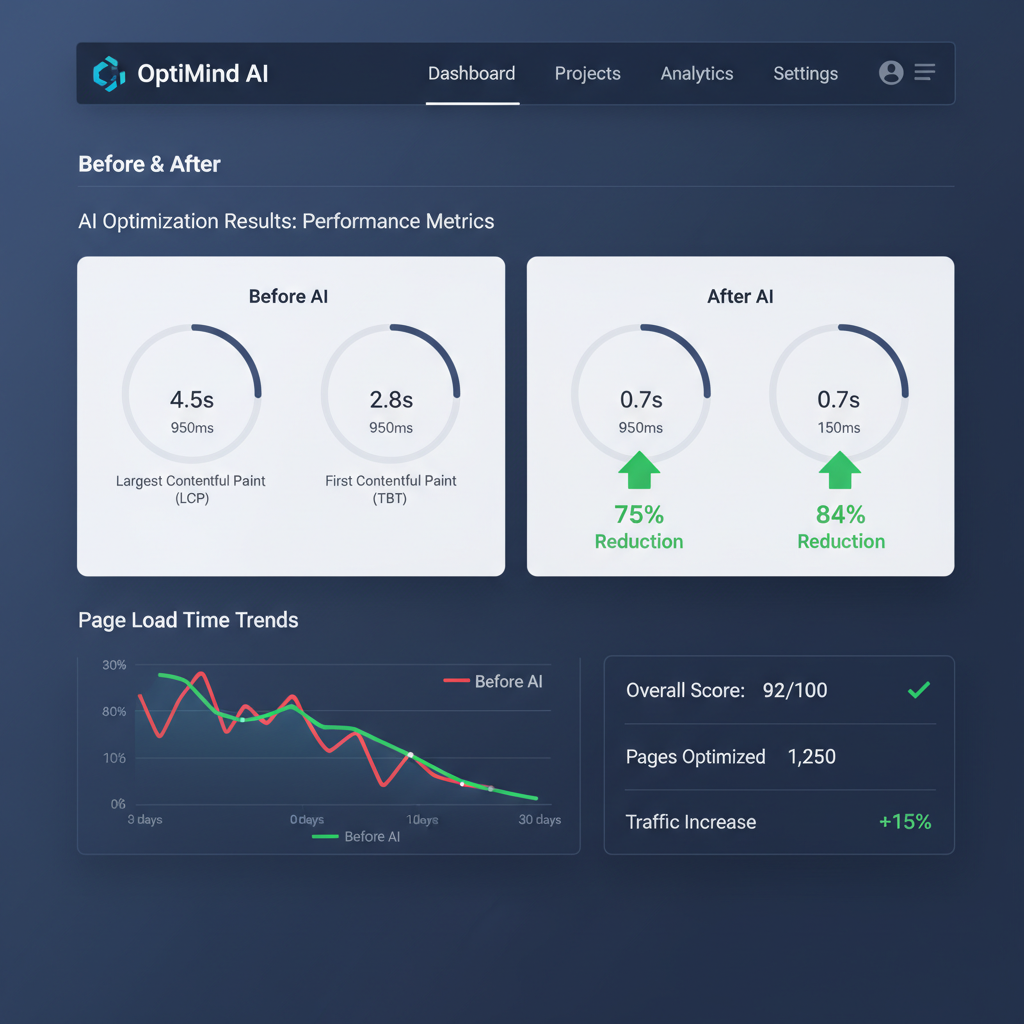
AI tools provide sophisticated “Before & After” analyses, quantifying improvements, often reporting impressive figures such as “X% reduction in load time” or “Y-point improvement in Core Web Vitals scores.” These metrics are not arbitrary; they reflect tangible gains in efficiency and user satisfaction.
Case Studies & Real-World Examples:
Consider “Aether Atelier,” a premium online boutique specializing in handcrafted jewelry. Facing high bounce rates on mobile, their Largest Contentful Paint (LCP) was a sluggish 3.8 seconds. After implementing Cloudinary’s AI-powered image optimization, which dynamically served WebP/AVIF formats and optimized compression based on device, their LCP improved dramatically to 1.9 seconds—a 50% reduction. This immediate visual responsiveness translated directly into a 22% increase in mobile conversion rates within a quarter, as users encountered a faster, more visually cohesive shopping experience that resonated with the brand’s luxury positioning.
Another example involves “Synapse Digest,” a high-traffic online magazine publishing cutting-edge technology content. Their Google PageSpeed Insights score was consistently in the “Needs Improvement” range, especially due to high Total Blocking Time (TBT) from extensive third-party scripts. By leveraging Nostra AI, an all-in-one platform that intelligently managed critical CSS extraction, JavaScript deferral, and asset preloading, Synapse Digest saw a 35% reduction in TBT and an 18-point increase in their overall Google PageSpeed Insights score (e.g., from 65 to 83). This led to a measurable 12% decrease in bounce rates and a significant uplift in organic search visibility for their competitive keywords, reinforcing their authority in the tech content space.
These examples underscore the capacity of AI tools for website speed optimization to deliver real-world results through strategic digital elevation. Understanding the reporting dashboards and analytics provided by AI tools is crucial for interpreting these results. These dashboards typically offer granular insights into each optimized asset, trend analyses over time, and comparative data against industry benchmarks, allowing for continuous refinement of optimization strategies.
For an in-depth look at measurable transformations, explore our Case Study: Achieving X% Page Speed Improvement with [Specific AI Tool].
Integrating AI Tools into Your Workflow: A Step-by-Step Guide
The strategic integration of AI tools into your digital workflow demands a methodical approach, ensuring seamless operation and maximum impact. This is a critical step for sustainable digital growth.
1. Assessment: Identifying Your Current Website Performance Bottlenecks
Begin with a comprehensive audit. Utilize tools like Google PageSpeed Insights, GTmetrix, and Lighthouse to generate detailed performance reports. Analyze Core Web Vitals scores, identify slow-loading assets, inefficient code, server response times, and pinpoint areas where AI could yield the most significant improvements. This diagnostic phase is critical for informed decision-making.
2. Selection: Choosing the Right AI Tool
The selection process should align with your specific needs, existing technology stack, and budgetary considerations.
- Needs: Are you focused on image optimization, code minification, CDN management, or an all-encompassing solution?
- Budget: AI tools vary widely in cost; evaluate the potential ROI against investment.
- Tech Stack: Ensure compatibility with your CMS (e.g., WordPress, Magento, custom platforms), hosting environment, and existing plugins or services. Look for tools that offer robust API integrations or dedicated plugins.
3. Implementation: Technical Steps for Integration
- API Integration: For advanced platforms, integration often involves configuring API keys and webhooks to connect the AI service with your website’s backend or CDN. This allows for dynamic, real-time optimization.
- Plugin Installation: Many AI tools offer user-friendly plugins for popular CMS platforms like WordPress. Installation typically involves downloading and activating the plugin, followed by configuration within your CMS dashboard.
- CDN Setup: If the AI tool provides CDN capabilities, this might involve updating DNS records to point to the AI-managed CDN, ensuring all content is routed through their optimized network.
- Initial Configuration: Most tools require an initial setup phase to define optimization rules, exclusions, and preferred performance targets.
4. Monitoring & Iteration: Best Practices for Continuous Optimization
Integration is just the beginning. Continuous monitoring and iterative refinement are paramount.
- Dashboard Analysis: Regularly review the performance dashboards provided by your AI tool. Track key metrics, identify any regressions, and understand the impact of AI’s autonomous adjustments.
- A/B Testing: Conduct controlled A/B tests to measure the specific impact of AI optimizations on user behavior and conversion metrics.
- Feedback Loop: Provide feedback to the AI system (where applicable) to refine its learning models and improve accuracy.
- Synergy with other SEO and web development practices: AI website speed optimization should not exist in isolation. It complements traditional SEO efforts (e.g., technical SEO audits, content strategy) and modern web development practices (e.g., progressive web apps, serverless architecture). A holistic strategy ensures that AI amplifies, rather than replaces, other crucial components of your digital presence.
For specific guidance on implementation, consult our guide on How to Integrate AI Speed Optimization Tools with WordPress (or specific CMS).
Are AI Website Optimization Tools Truly Effective? Limitations and Considerations
The advent of AI tools for website speed optimization has naturally sparked both enthusiasm and skepticism. A discerning perspective is essential to evaluate whether these sophisticated solutions are truly worth the investment for a brand aspiring to strategic digital positioning.
Effectiveness: Evidence and Data Supporting Their Claims
The evidence strongly supports the efficacy of AI tools for website speed optimization. Studies and real-world implementations consistently demonstrate:
- Tangible Metric Improvements: Significant reductions in Page Load Time, LCP, TBT, and FCP are routinely observed.
- Enhanced User Experience: Faster sites correlate directly with lower bounce rates, increased time on page, and improved engagement.
- SEO Uplift: Google explicitly prioritizes page speed and Core Web Vitals, making AI-driven improvements a direct contributor to higher search rankings.
- Conversion Rate Increases: E-commerce sites, in particular, report measurable boosts in conversion rates when speed is optimized.
The capacity of AI to process vast amounts of data, learn from patterns, and make real-time, adaptive adjustments far surpasses manual capabilities. The unique advantage of these AI tools for website speed optimization lies in their ability to provide continuous, dynamic optimization without human intervention once configured, adapting to changes in content, traffic patterns, and user behavior.
Potential Limitations and Considerations
While powerful, AI is not a panacea.
- Cost: Advanced AI platforms represent a significant investment, making careful ROI analysis crucial.
- Learning Curve: While designed for automation, mastering the configuration and interpretation of complex AI tools can require time and expertise.
- Over-reliance: An over-reliance on AI without human oversight can lead to suboptimal outcomes if fundamental issues are not addressed.
- Compatibility Issues: Highly customized or legacy website architectures might encounter compatibility challenges with some AI tools.
- Human Oversight Still Required: AI excels at execution, but strategic direction, nuanced problem-solving, and quality assurance still require human intelligence and expertise.
When AI Might Not Be The Complete Solution
AI optimization builds upon a healthy foundation. It might not be the complete solution if your website suffers from:
- Fundamental Server Issues: Poor hosting infrastructure, inadequate server resources, or misconfigured servers can bottleneck even the most advanced AI optimizations.
- Badly Structured Content Management Systems (CMS): An inefficient or bloated CMS can create underlying performance issues that AI tools can mitigate but not fully resolve.
- Legacy Code Debt: Deep-seated issues in legacy codebases may require manual refactoring before AI can yield its full potential.
Return on Investment (ROI): Justifying the Expense
Justifying the expense of AI website optimization tools necessitates a clear understanding of the ROI. The investment translates into:
- Improved SEO Performance: Higher rankings, increased organic traffic.
- Enhanced User Experience: Greater engagement, reduced frustration.
- Increased Conversion Rates: More leads, sales, or desired user actions.
- Operational Efficiency: Reduced manual effort for optimization, allowing teams to focus on strategic initiatives.
The long-term value of a meticulously optimized digital presence, particularly for discerning brands, often far outweighs the initial financial outlay, positioning the brand for sustained authority and trust.
To delve deeper into the financial implications and strategic advantages, consider our analysis on The ROI of AI Website Speed Optimization Tools: Is It Worth the Investment?
Future Trends in AI for Website Performance
The landscape of AI and web optimization is in a state of continuous, rapid evolution, promising an even more intelligent and responsive digital future. As digital strategists constantly observe the horizon for visionary enterprises, we anticipate several transformative trends.
Emerging technologies are pushing the boundaries of what’s possible. We foresee advanced predictive capabilities becoming even more sophisticated, allowing AI to not just react to patterns but to anticipate user intent and network conditions with unprecedented accuracy. This means websites will not merely load quickly; they will adapt almost presciently to individual user needs, pre-loading only what is absolutely necessary, exactly when it is needed.
Personalized user experiences driven by AI and speed will move beyond basic demographic segmentation. AI will enable micro-personalization, where every element—from content blocks to call-to-action placement—is dynamically optimized for speed and relevance based on real-time behavioral cues, device capabilities, and even emotional context. This creates a deeply engaging and uniquely efficient journey for each user, reinforcing brand connection.
Furthermore, AI’s role in the next generation of Core Web Vitals will be pivotal. As Google’s metrics evolve to capture more nuanced aspects of user experience, AI will be instrumental in deciphering these new signals, optimizing for factors like responsiveness to interactions, visual stability across diverse viewports, and efficient resource allocation under varying network conditions. AI will transform these complex requirements into actionable, autonomous optimizations, ensuring that digital influence remains accessible and sustainable for visionary brands. The symbiotic relationship between AI and website performance is not just a trend; it is the definitive trajectory of a more engaging, efficient, and intelligent web.
For an expansive perspective on the coming advancements, explore our thought piece on the Future of Website Performance: AI and Predictive Optimization.
Frequently Asked Questions
What are Core Web Vitals and why are they crucial for website speed?
Core Web Vitals are a set of specific metrics developed by Google that measure real-world user experience for loading performance, interactivity, and visual stability of a webpage. They include Largest Contentful Paint (LCP), Interaction to Next Paint (INP), and Cumulative Layout Shift (CLS). They are crucial because they directly impact SEO rankings, user satisfaction, and ultimately, conversion rates, serving as a benchmark for what constitutes a high-quality user experience.
How does AI actually optimize images without compromising quality?
AI optimizes images by employing advanced algorithms that analyze the content of each image. It identifies redundant data and applies intelligent compression techniques tailored to the image’s characteristics, often converting them to more efficient next-gen formats like WebP or AVIF. Crucially, AI can dynamically adjust compression levels based on the user’s device, screen size, and network conditions, delivering the smallest possible file size without a perceptible loss in visual quality, ensuring a balance between aesthetics and performance.
Is AI website speed optimization suitable for small businesses and boutique brands?
Yes, AI website speed optimization is increasingly suitable for small businesses and boutique brands. While some enterprise-level solutions can be costly, many AI tools now offer tiered pricing or more focused solutions that are accessible. For these brands, speed is paramount for establishing credibility and competing effectively. The automated nature of AI tools means less manual effort, allowing smaller teams to achieve professional-grade optimization without dedicated in-house technical experts, thus democratizing access to superior digital performance.
What is the typical Return on Investment (ROI) for investing in AI website speed optimization tools?
The typical ROI for AI website speed optimization tools can be substantial and multifaceted. Businesses often report significant improvements in SEO rankings, leading to increased organic traffic. Enhanced user experience results in lower bounce rates and higher engagement. Most critically, for e-commerce or lead generation sites, these improvements often translate into measurable increases in conversion rates and sales. While specific percentages vary, the combination of improved visibility, user satisfaction, and direct revenue impact often justifies the initial investment, providing a strong strategic advantage.
Conclusion: Mastering the Digital Pace with AI
The journey toward strategic digital presence is characterized by precision, foresight, and continuous optimization. We have explored the clear advantages that AI brings to website speed optimization—from intelligent automation and real-time adjustments to predictive analytics and continuous improvement. For discerning brands, embracing AI is not merely about technical enhancement; it is a strategic imperative that translates into superior user experiences, elevated SEO rankings, and ultimately, sustained authority and trust in the digital landscape.
The limitations and considerations, while present, are manageable with informed decision-making and strategic oversight. The future promises an even more integrated and intuitive web, where AI will personalize and accelerate every digital interaction. Neglecting this transformative power is to concede a crucial advantage in the competitive digital ecosystem. Will your brand merely keep pace, or will it lead the charge in shaping a faster, more engaging, and influential web experience? The choice to strategically adopt AI for website speed optimization today is a pivotal step toward that leadership.